

|
Shipping damage costs the average B2B operation $10–$20 per claim in operational overhead alone - before replacing the product. Industry benchmarks show 3–4% of parcel shipments and 2–5% of LTL freight arrive damaged. The 10-point checklist below covers the packaging spec changes, packing station protocols, and carrier tracking systems that consistently bring damage rates below 1% in high-volume operations. |
Why Your Damage Rate Is Probably Higher Than You Think
Most operations managers track customer complaints about damage. Far fewer track the actual damage rate the percentage of all shipments, not just the ones that generate a complaint. Those two numbers are wildly different.
Industry benchmarks: according to Packaging Digest, approximately 11% of goods arrive at distribution centers in damaged condition. For parcel carriers, UPS runs roughly 11% damage, USPS 10%, and FedEx 7% across all package types (Contimod, 2025). For LTL freight the mode most B2B shippers depend on for heavy or pallet-sized shipments, damage rates run 2–5% per shipment due to the multiple-handling profile of terminal-to-terminal routing.
The financial model most operations miss is the stack of costs behind each claim. Each damaged shipment carries: the replacement product cost, $10–$20 in operational overhead for processing the return and reshipping (Shopify estimate), the customer service labor time, and the one that never shows up in a claims report: a 51% probability that the affected customer does not repurchase from you (Flowspace, 2025). For high-value B2B products with repeat purchase cycles, that last number is the most expensive line item on the list.
The good news: effective packaging and operations improvements reduce damage rates by up to 40% according to Packaging Digest research. The checklist below is structured around the interventions that drive most of that improvement.
Before the Checklist: Calculate Your Actual Damage Rate
Run this number before you do anything else. Without a baseline, you cannot measure whether interventions are working.
Damage Frequency Rate = (Number of damaged shipments ÷ Total shipments shipped) × 100
Damage Cost Rate = (Total cost of all damage claims ÷ Total freight spend) × 100
Track both metrics monthly, broken down by carrier and if you have the data by packer or packing line. Operations that track damage at this level find the root cause within 60 days in nearly every case. Operations that track only total complaints find out six months later when a major account churns.
Your benchmark targets: below 2% damage frequency rate is considered optimal for e-commerce operations; below 1% is achievable with the steps below for parcel shipping. LTL operations should target below 1.5%.
The 10-Point Shipping Damage Reduction Checklist
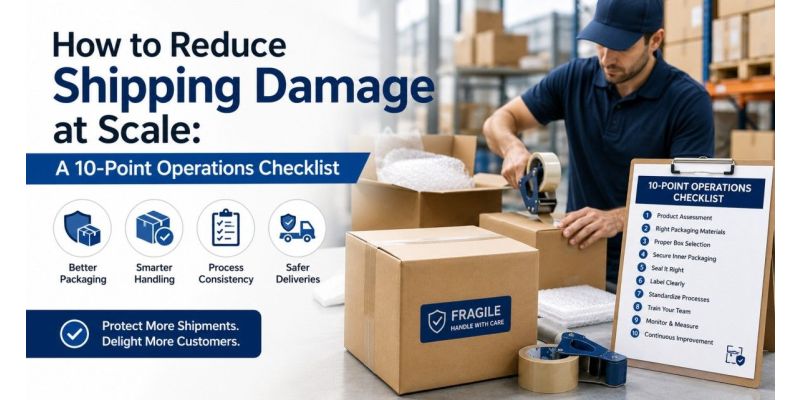
Work through these in order. Points 1–3 are spec-level changes that require purchasing decisions. Points 4–7 are execution-level changes that require SOPs and team training. Points 8–10 are the management systems that sustain everything else.
Point 1: Audit Your Box ECT Rating Against Your Actual Product Weights
This is the most common and most expensive packaging spec error in B2B operations. The standard 32 ECT single-wall box handles items up to approximately 40–65 lbs under ideal handling conditions. Under real-world conditions, it handles significantly less because each handling cycle degrades effective ECT by 20–30%.
A 32 ECT box after one sorting-belt pass effectively becomes a 22–25 ECT box. If that box is then stacked four-high in a delivery truck, every box below the top is carrying compressive load it was never tested for. The boxes fail at the bottom corners first exactly where most crush damage originates.
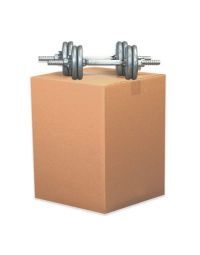
For any product over 40 lbs, or any box that will be stacked more than two units high in storage or transit, upgrade to double-wall 275lb construction. The cost premium is 50–75% per box, but the damage claim rate on properly specced double-wall boxes drops to near zero for weight-related failures. We cover the full ECT selection framework in our guide to heavy duty shipping boxes and when to upgrade.
Point 2: Right-Size Your Boxes
Oversized boxes are one of the leading causes of in-transit product damage and one of the most overlooked. When an item occupies less than 70% of a box by volume, it has room to shift, rotate, and bounce during handling. A 5-inch shift inside a box during a conveyor transfer creates an impact force equivalent to dropping the item from several inches.
The right-size rule: the box should be the smallest size that holds the product plus 2 inches of void fill on all six sides. No more, no less. For a product that is 12"×10"×8", the right box is 16"×14"×12" not the nearest convenient size that fits. Inconsistent box sizing also complicates stacking in trucks and warehouses, which creates secondary damage risk.
Oversized boxes also trigger FedEx Additional Handling Charges on packages exceeding 10,368 cubic inches (effective January 2026). Right-sizing is simultaneously a damage reduction strategy and a carrier cost reduction strategy.
Point 3: Standardize Your Void Fill Protocol
The most common void fill failure mode is not using the wrong material it is inconsistent application by packers under time pressure. A packing spec that says "fill voids with packing peanuts" gives a packer discretion to interpret "full" differently on every shift. That discretion is where damage happens.
The protocol that eliminates the discretion: before sealing any box, the product must not move when the sealed box is shaken. That is the test. If it shifts, add more void fill. If it does not shift, the box is ready to seal.
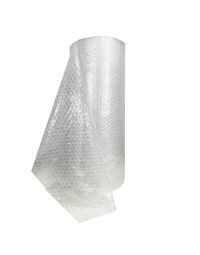
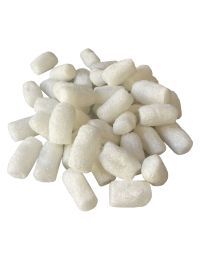
For high-volume operations, the right void fill choice depends on the product weight and the handling path. Packing peanuts (bio or standard) are best for oddly shaped items and large void volumes. Bubble roll 3/16" for lightweight fragile items, 5/16" or 1/2" for heavier items works best as a wrap-and-fill combination for items with defined surfaces. Our guides to packing peanut types and uses and bubble roll sizes cover the selection framework.
Point 4: Implement the H-Tape Pattern on Every Box
The H-tape pattern is the most reliable bottom seam for boxes over 25 lbs, and it takes approximately 3 seconds longer than the standard center-seam tape that most packing operations default to. Run one strip of heavy-duty packing tape along the center seam, then one strip perpendicular across each end forming an "H." This distributes load across the full width of the base rather than relying on the center seam alone.
For boxes over 50 lbs, tape the bottom twice two complete H-patterns. The seam at the bottom corners is where corrugated boxes fail under drop and compression forces. The H-pattern specifically reinforces those corners.
Critically: do the same pattern on the top seam. Carriers stack, sort, and invert packages in ways shippers do not intend. A box with a weak top seam that gets inverted at a sorting facility distributes its contents unevenly, often causing the base seam to fail.
Point 5: Wrap Fragile Items Before Placing in the Box
Bubble wrap and foam wrap protect against surface damage, abrasion, and light impacts. Packing peanuts protect against shifting and void-related movement. These are two different protective functions and they work together, not interchangeably.
The correct sequence: (1) wrap the item in bubble roll, bubbles facing inward, secured with tape on the flat side; (2) place a base layer of packing peanuts or foam padding in the box; (3) place the wrapped item in the center of the box, not against any wall; (4) fill voids on all six sides; (5) apply the H-tape pattern.
Operations that skip Step 1 placing unwrapped items directly in peanuts see higher rates of surface damage (scratches, chips, abrasion) because peanuts allow micro-movement that bubble wrap prevents. Operations that skip Step 2 see higher rates of corner and bottom damage from drops.
Point 6: Build Carrier-Specific Packaging Protocols
UPS, FedEx, USPS, and LTL freight carriers have meaningfully different handling profiles. A packaging spec designed around FedEx Ground handling will underperform for USPS parcel (which ISTA data shows handles packages rougher than FedEx on average) and significantly underperform for LTL freight (which involves forklift handling, terminal consolidation, and multiple load/unload cycles).
Minimum carrier-specific adjustments:
- USPS parcel: plan for rougher handling than the label implies. Use 3/16" bubble wrap as standard. The USPS damage rate is approximately 10% across all package types, the highest of the three major domestic parcel carriers.
- UPS/FedEx Ground: plan for conveyor belt drops and multi-level stacking. The H-tape double bottom is standard for packages over 50 lbs.
- LTL freight: any item shipped LTL should be double-wall corrugated as a minimum spec. LTL runs 2–5% damage rates due to terminal handling. Add corner protectors for palletized shipments. Ensure pallet wrap is applied at minimum 250% wrap force per ASTM D4169 guidelines.
- Freight/intermodal: add moisture barriers (desiccants, poly bags) for shipments with multi-day transit through varying climate zones.
Point 7: Document and Photograph Outbound Shipments
When a carrier delivers a damaged package, the damage claim requires proof that the item left your facility undamaged. Without outbound documentation, the carrier can dispute the claim, and most do, unless the damage is obvious external deformation.
The documentation protocol that survives carrier disputes: photograph the item before packing, the item inside the box with void fill visible, and the sealed box before it leaves the facility. Store photos indexed by tracking number. This takes approximately 45 seconds per package and reduces disputed claim rates dramatically.
For high-value shipments, include a packing slip inside the box that identifies the packer by name or employee number. This both enables internal accountability and demonstrates to the carrier that a trained individual packed the shipment, useful context in damage investigations.
Point 8: Track Damage by Carrier, Route, and Packer
Without disaggregated data, every damage event looks like a random occurrence. With disaggregated data, patterns emerge within 60–90 days that identify the actual root cause.
Build a damage log with these five fields for every incident: date, carrier, destination region, packer ID (if available), and the failure mode (crush, moisture, shifting, surface damage). Review the log monthly and look for concentration. If 60% of your damage events involve a specific carrier, you have a carrier problem. If they concentrate on specific packer IDs, you have a training problem. If they concentrate on specific products, you have a spec problem.
Operations that have never done this analysis are usually surprised by what they find. The Pareto principle applies: in most high-volume shipping operations, 80% of damage claims come from 20% of the causes, and that 20% is almost always findable with 90 days of tracking.
Point 9: Train Your Team With a Written Packing Standard
Verbal training degrades on every shift. The third-generation employee who trained on verbal instructions from someone who trained on verbal instructions from the original procedure has an unknown relationship with the original intent. A written packing standard, one page, with photos, laminated and posted at every packing station, eliminates this drift.
The packing standard should cover five things: how to select the correct box size for the product, how to apply the first wrap layer, how to fill voids correctly (including the shake test), how to apply the H-tape pattern, and what to do when in doubt (check with the supervisor, not skip the step). Review the standard quarterly and update it when damage patterns reveal execution gaps.
The 20% of operations cost savings from packaging improvements that companies report typically comes from consistent application of an existing spec, not from upgrading to more expensive materials.
Point 10: Set a Damage Rate KPI and Review It at Every Operations Meeting
The single most reliable predictor of whether a packaging improvement initiative sustains is whether the damage rate is tracked and reviewed at the operations management level. When it is tracked, it improves. When it stops being tracked, it drifts back within 6–12 months.
Set the target: below 2% damage frequency rate is the industry standard floor. Below 1% is achievable for parcel operations that have implemented the nine points above. Below 0.5% is achievable for parcels with mature packaging specs and packing SOPs.
Put it on the wall. Literally. A monthly damage rate chart posted in the packing area connects every packer to the outcome of their work. That visibility changes behavior without enforcement, without additional training, without any additional spend.
How Much Can You Actually Save?
Here is the math for a typical mid-size B2B operation shipping 2,000 packages per month with a 3.5% damage rate (70 damaged packages) and an average product value of $85:
|
Cost Category |
Current (3.5% damage) |
After (1.0% damage, 20 claims) |
|
Replacement product cost ($85/unit avg) |
$5,950/month |
$1,700/month |
|
Operational overhead ($15/claim avg) |
$1,050/month |
$300/month |
|
Return shipping (est. $8/return) |
$560/month |
$160/month |
|
TOTAL DIRECT COST |
$7,560/month |
$2,160/month |
|
Annual savings from 2.5% improvement |
— |
$64,800/year |
The customer retention impact is not included in this calculation, but it is real. At a 51% repurchase loss rate per damage event and an average customer LTV of $2,000, the 50 recovered customers per month in the above scenario represent $100,000 in retained annual revenue.
The packaging and operations investments required to move from 3.5% to 1.0% primarily a box spec upgrade to double-wall and a void fill standardization, typically cost $200–$600 per month in incremental materials for an operation at this volume. The ROI is 100x.
Frequently Asked Questions
1. What is an acceptable shipping damage rate?
Industry benchmarks consider below 2% damage frequency rate optimal for e-commerce operations. Below 1% is achievable for parcel operations with proper packaging spec and packing SOPs. LTL freight operations typically run higher, with 1–2% considered strong performance due to the multiple-handling profile. Track your rate monthly and compare against your own historical baseline as well as these benchmarks.
2. What is the most common cause of shipping damage?
The three leading causes are: improper packaging (wrong box spec for the product weight, insufficient void fill, or missing wrap layer), rough carrier handling (conveyor drops, sorting impacts, stacking pressure), and box seal failure (center-seam-only tape that gives way under load). Of these, improper packaging is the one shippers control directly and where the most improvement comes from.
3. How do I calculate my shipping damage rate?
Divide the number of damaged shipments by total shipments shipped, then multiply by 100. For example, 14 damage claims on 700 monthly shipments equals a 2% damage rate. Track this monthly by carrier and product type to identify root causes. Also calculate your damage cost rate: total damage claim costs divided by total freight spend.
4. Does double-wall corrugated significantly reduce shipping damage?
Yes, specifically for weight-related and crush-related failures, which are among the most common damage modes in B2B shipping. Double-wall 275lb corrugated cartons resist stacking compression significantly better than standard 32 ECT single-wall boxes, and they maintain structural integrity across more handling cycles. The ECT rating of a single-wall box degrades 20–30% per use cycle; double-wall holds its rating longer under the same conditions.
5. What void fill material is best for B2B shipping?
For heavy and oddly shaped items, packing peanuts (standard Styrofoam or biodegradable) provide the best void coverage because they conform to any shape. For items that need both surface protection and void fill, bubble roll 3/16" for lightweight items, 5/16" for heavier items works as both a wrap and a void filler. For high-volume warehouse operations, air pillows are the most labor-efficient option for lightweight products. Never use one material to do the job of two.
6. How do I file a shipping damage claim with UPS or FedEx?
Document the damage immediately: photograph the box exterior (including any carrier damage stickers or notation), the box interior showing the packaging materials, and the damaged product. Do not discard any packaging materials until the claim is resolved. File the claim online with UPS (ups.com/claims) or FedEx (fedex.com/claims) within 9 calendar days (FedEx) or 60 days (UPS) of delivery. Outbound photographs of the sealed package significantly improve claim success rates in disputed cases.
7. What is the H-tape pattern for shipping boxes?
The H-tape pattern is the recommended sealing method for boxes over 25 lbs. Apply one strip of tape along the center seam, then one strip perpendicular across each end creating an H shape. This distributes load across the full width of the box base rather than relying solely on the center seam. For boxes over 50 lbs, apply two complete H-patterns on the bottom seam. Apply the same pattern on the top.
Building a Systematic Approach to Shipping Damage Reduction
Shipping damage is not a random occurrence it is a measurable, manageable operational metric. The operations that consistently achieve below 1% damage rates are not using more expensive packaging materials than their competitors. They are using the right packaging materials, applied consistently, by trained teams, tracked against a monthly KPI.
The most common point of failure is Point 1: box spec that does not match actual product weights under real handling conditions. If your operation ships anything over 40 lbs in a standard 32 ECT box, that is the first thing to change.
StarBoxes stocks the full range of 275lb double-wall heavy-duty boxes (8"×8"×8" through 24"×24"×24"), bubble rolls in all three sizes for void fill and surface protection, and packing peanuts in bulk quantities all at wholesale pricing.
Ready to upgrade your packaging spec? Shop heavy-duty boxes and bulk bubble rolls or request a custom bulk quote for volume pricing on cases and pallet quantities.