

|
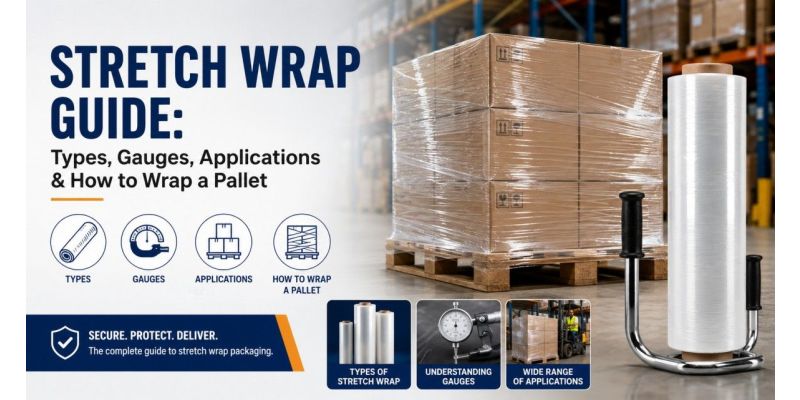
Stretch wrap (also called stretch film or pallet wrap) is a highly stretchable polyethylene plastic film stretched tightly around palletized loads, bundled items, or products to unitize them for storage and shipping. It comes in two main types, cast and blown, in hand wrap and machine wrap formats, and in gauges from 60G (light duty) to 150G+ (industrial). For most warehouse pallets, 80G cast hand stretch wrap is the industry standard starting point. |
What Is Stretch Wrap - and How Is It Different from Shrink Wrap?
Stretch wrap is a linear low-density polyethylene (LLDPE) film engineered to stretch up to 200–300% of its original length while retaining elastic memory. When you stretch it around a pallet and let go, it tries to return to its original dimensions; that elastic recovery is what creates containment force, the inward pressure that holds the load together and to the pallet during transit.
Shrink wrap is a different product that serves a different purpose. Shrink wrap is applied loosely around items and then heated with a heat gun, causing it to contract and form a tight seal. Stretch wrap requires no heat and no special equipment for basic hand-wrapping applications. Stretch wrap is also reusable if removed carefully; shrink wrap is not.
The practical difference: stretch wrap is what you use to secure pallet loads and protect items from shifting, dust, and moisture during freight shipping and warehouse storage. Shrink wrap is what you use to create tamper-evident retail packaging, bundled multipack products, and heat-sealed consumer goods.
Cast vs. Blown Stretch Film: The 7-Factor Comparison
Every stretch wrap purchase starts with this decision. Cast and blown stretch wrap refer to the manufacturing process, and that process determines how the film performs in your specific operation.
Cast film: molten polyethylene resin is extruded through a flat slot die and cooled rapidly on chilled rollers. The fast, uniform cooling creates a film with high clarity, consistent thickness, and quiet unwind. Around 70–80% of global stretch film use is now cast film.
Blown film: molten resin is extruded through a circular die and blown upward into a tube, which is then cooled more slowly by air. The slower cooling creates a more crystalline molecular structure with higher puncture resistance and stronger memory but at the cost of clarity and noise.
|
Factor |
Cast Stretch Film |
Blown Stretch Film |
Which to Choose |
|
Clarity |
Crystal clear - barcodes and labels easily scanned through the film |
Hazy, translucent - harder to read labels |
Cast when product visibility or barcode scanning matters |
|
Unwind noise |
Nearly silent |
Loud, crinkly sound during application |
Cast in noise-sensitive facilities |
|
Puncture resistance |
Good - but tears propagate easily once punctured (unidirectional) |
Superior - biaxial molecular structure resists tear propagation |
Blown for sharp edges, irregular shapes, rough loads |
|
Cling type |
Two-sided cling - can cause pallets to stick together in storage |
One-sided cling - strong load retention, pallets release cleanly |
Blown when pallets are stored stacked or side-by-side |
|
Temperature performance |
Standard - suitable for most indoor environments |
Excellent in cold storage, freezers, outdoor shipments |
Blown for cold chain and outdoor exposure |
|
Cost |
Lower - faster manufacturing process |
Higher - slower production, more expensive per roll |
Cast for cost-sensitive standard operations |
|
Best for |
Standard boxed pallets, high-volume machine wrapping, barcode scanning environments |
Irregular loads, sharp-edged products, heavy freight, cold storage, cross-country transit |
Match to load type first; budget second |
One thing worth knowing: modern resin technology has narrowed the performance gap. A high-quality 80G cast stretch film can match an older 100G blown film in load retention on standard box pallets. When in doubt, start with cast and upgrade to blown if you see film breaks or damage reports on loads with sharp edges or irregular shapes.
Hand Wrap vs. Machine Stretch Film: When to Upgrade
Hand stretch wrap and machine stretch wrap differ in more than just roll size. Machine wrap is specifically engineered to be run through a stretch wrapping machine at high pre-stretch ratios, typically 200–300%, compared to the 100–150% a person can achieve by hand. That difference in pre-stretch directly affects both film usage and containment force per wrap.
|
Factor |
Hand Stretch Wrap |
Machine Stretch Wrap |
|
Application |
Manual - walk around the pallet holding the roll or using a dispenser |
Automated - turntable, rotary arm, or robotic stretch wrapper |
|
Typical roll size |
18" wide, 1,000–1,500 feet |
20" or wider, 5,000+ feet per roll |
|
Pre-stretch ratio |
100–150% (human-applied) |
200–300% (mechanically applied) |
|
Containment force consistency |
Variable - depends on operator technique |
Highly consistent - machine applies uniform tension |
|
Film cost per pallet |
Higher - less efficient stretch |
Lower - machine extracts more length per roll |
|
Labor time per pallet |
3–5 minutes (hand) |
60–90 seconds (semi-auto); 30–60 seconds (full auto) |
|
Capital investment |
$0–$50 (dispenser only) |
$2,000–$25,000+ (semi-auto to automatic) |
|
Break-even volume |
1–14 pallets per day |
15–20+ pallets per day is the typical break-even |
The 15-per-day threshold is widely cited in the industry as the point where machine wrapping pays for itself in labor savings and reduced film cost. Below that, a quality hand dispenser and 80G cast hand film is the practical choice. Above it, the ROI on even a semi-automatic turntable wrapper is typically under 12 months.
Stretch Film Gauge Guide: Choosing the Right Thickness for Your Load
Gauge is the single most consequential specification in stretch wrap selection and the one most often chosen incorrectly. The rule of thumb is simple: heavier loads need higher gauges. But the nuance matters for operations that want to optimize cost without sacrificing load integrity.
1 gauge = 0.254 microns. The industry standard, 80G, measures 20.3 microns thick. It is the default because it balances material cost, availability, hand and machine compatibility, and containment force across the widest range of standard warehouse loads. According to industry benchmarks, 80G film handles loads up to approximately 2,200–2,400 lbs effectively under standard parcel and freight conditions.
|
Gauge |
Load Capacity |
Film Type |
Best For |
Notes |
|
37G |
Under 800 lbs |
Pre-stretched hand film |
Light uniform loads, bundling small items, office use |
This IS 80G film pre-stretched at manufacturing. Lightweight, easy to apply, minimal effort. Not for sharp edges. |
|
47G |
Up to 1,800 lbs |
Equivalent/hybrid film |
Standard boxed loads without sharp edges, e-commerce fulfillment |
Stiffer than true 60G. Often used as a cost-efficient alternative. Cannot be stretched much further by hand. |
|
60G |
Up to 1,800 lbs |
True gauge cast or blown |
Light-medium boxed pallets, manual wrapping, auto/semi-auto machines |
Best elongation in its range. Good for both banding operations and standard hand-wrap pallets. |
|
70G |
Up to 1,500 lbs |
True gauge cast |
E-commerce boxes, retail pallets, uniform loads, no sharp edges |
Popular in fulfillment centers for consistent boxed-product loads. |
|
80G |
2,200–2,400 lbs |
Cast (most common) or blown |
Industry standard: mixed warehouse loads, standard distribution pallets |
The correct starting spec for most operations. StarBoxes 18" x 1500ft 80G Cast Black is the top-selling hand wrap SKU. |
|
90G |
2,400–2,600 lbs |
Cast or blown |
Medium-heavy pallets, loads with some shape irregularity, longer haul freight |
The next step when 80G is stretching too thin or breaking. StarBoxes stocks 18" x 1500ft 90G Blown. |
|
100G |
2,800–3,000 lbs |
True gauge - cast or blown |
Heavy pallets, irregular loads, steel drums, industrial components |
Hand application becomes physically demanding at 100G. Semi-auto or machine recommended. |
|
115G |
3,000+ lbs |
True gauge - usually blown |
Very heavy or sharp-edged loads, steel beams, construction materials |
Machine application effectively required for consistent results. |
|
150G+ |
3,500+ lbs |
True gauge - blown or specialty |
Industrial freight, extreme-duty, heavy machinery components |
Always machine-applied. Cost per roll is significantly higher, but essential when lower gauges fail. |
Important note on true-gauged vs. equivalent film: Some films labeled 80G are 'equivalent' films; they perform like 80G in load retention but measure thinner on a micrometer due to a stiffer resin formula. Equivalent films are not inherently worse, but they have lower elongation and less cushioning on sharp-edged loads. When in doubt, ask for 'true-gauged' 80G film for the widest versatility.
The StarBoxes Stretch Wrap Range: 8 Product Types
StarBoxes stocks the full spectrum of stretch film types, from light-duty hand film to heavy-duty machine wrap. Here is what each category is, when to use it, and what to expect.
Cast Stretch Wrap
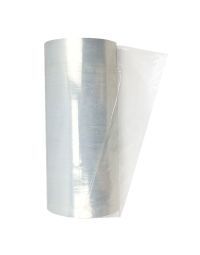
The industry workhorse. Crystal-clear, quiet-unwind, consistent-gauge film for standard pallet loads. Available in 80G and 90G, 18" wide, 1,500' rolls. Best for: most warehouse and distribution center applications, machine-wrap environments, and any situation where barcode scanning through the film is required. Shop cast stretch wrap.
Blown Stretch Wrap
Higher puncture resistance, stronger memory, better cold-weather performance. Slightly hazy, noisier to apply. Available in 90G, 18" wide, 1,500' rolls. Best for: loads with sharp edges or irregular shapes, cold storage and freezer applications, long-haul or rough-handling freight. Shop blown stretch wrap.
Extended Core Wrap
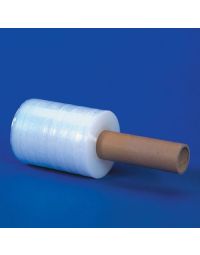
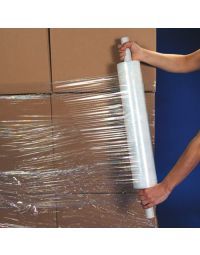
The same cast or blown film on a roll with an extended cardboard core that serves as a built-in handle. No separate dispenser required; operators grip the core directly and walk the pallet. Best for: low-to-mid volume operations that want ergonomic hand wrapping without a dedicated dispenser investment. Shop extended core wrap.
Opaque Stretch Wrap
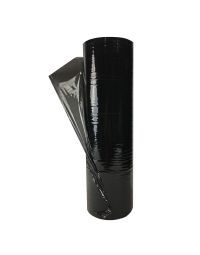
White, black, or colored stretch film for applications where load visibility should be restricted. Best for: security-sensitive shipments (concealing high-value contents), color-coded warehouse organization (different colors for different product lines or destinations), outdoor storage where UV protection matters. Shop opaque stretch wrap.
Pipe Wrap
Specialty stretch film engineered for wrapping cylindrical, elongated, or bundled items: pipes, rods, rebar, lumber, conduit, cable reels. Narrower width with high cling for tight spiral wrapping around circumferences that standard pallet film covers poorly. Best for: metal service centers, lumber yards, construction materials distributors. Shop pipe wrap.
Machine Stretch Wrap
Designed specifically for use with turntable, rotary arm, or robotic stretch wrappers. Available in wider widths (20"+) and longer rolls (5,000'+) than hand wrap. Engineered to run at the 200–300% pre-stretch ratios that automated machines apply. Do not use machine wrap by hand at proper machine tension; it is nearly impossible to apply manually, and at hand tension, it wastes the film properties. Shop machine wrap.
Stretch Dispensers
Hand tools that hold a standard 12"–18" stretch film roll and allow operators to apply consistent tension while walking around a pallet. Range from simple handle-cap dispensers (two-handle grip for film ends) to brake-equipped dispensers (add controlled resistance for higher tension) to floor-standing roll stands. Shop stretch dispensers.
If your team is currently wrapping pallets without any dispenser, bare-handing a roll upgrade to a dispenser immediately. Bare-hand wrapping creates uneven tension, higher film consumption, and ergonomic strain. A $20 handle dispenser eliminates all three.
How to Stretch Wrap a Pallet with Hand Film - Step by Step
This technique applies to hand-wrap pallets using any standard 18" roll with a handle or dispenser. For machine wrapping, set wrap parameters per your machine manufacturer guidelines.
Step 1: Stack and inspect the load.
Arrange items with heaviest at the bottom, lightest at the top. Center the load on the pallet; don't let product overhang the pallet edges. Ensure nothing is loose or protruding. A load that shifts before you start wrapping will shift worse during transit.
Step 2: Anchor the film to the pallet base.
Pull out 12–18 inches of film from the roll. Either tuck it between load boxes at the base or twist it into a loose rope and wrap it around the pallet frame itself. The anchor point needs to be low at the junction between the load and the pallet deck boards.
Step 3: Wrap the base: 3 - 4 complete revolutions.
Walk around the pallet keeping the film low, at the pallet deck level. Make 3 - 4 complete revolutions, maintaining tension and keeping each wrap at the same height. This base layer creates the cable that locks the load to the pallet.
Step 4: Create the pallet cable lock.
On the last base revolution, twist the film into a tight rope/cable and drive it down just below the top deck boards of the pallet, not all the way to the ground. This cable must sit high enough that forklift tines slide under it without piercing the film when the pallet is moved.
Step 5: Spiral upward: 40–60% overlap per pass.
Begin walking in an upward spiral, angling the film slightly with each revolution so it rises up the load. Each pass should overlap the previous by 40–60% of the film width. For an 18" roll, this means each upward pass covers 7–11 inches of new height. Maintain consistent tension; do not let the film go slack.
Step 6: Extra revolutions at the middle (if needed).
For tall or unstable loads, add 2–3 extra revolutions around the center of mass (approximately halfway up) before continuing upward. Tall, narrow loads or mixed-height loads particularly benefit from this.
Step 7: Wrap the top: 3–4 revolutions, extending 2–6" above the load.
At the top of the load, make 3–4 complete revolutions. Angle the film slightly downward to cover the top edges of the boxes. The film should extend 2–6 inches above the highest point of the load to protect the top surface from dust and debris during storage.
Step 8: Spiral back down (optional for heavy loads).
For loads over 2,000 lbs or loads with any stability concern, reverse direction and spiral back down after reaching the top. This double-wrap pass significantly increases containment force without requiring a second application.
Step 9: Cut, tuck, and inspect.
Cut the film from the roll and tuck the loose tail under the previous wrap layer, or press it firmly against the film (the cling will hold it). Shake the pallet gently; nothing should shift. If any section feels loose, add wrap there before the pallet moves.
Common mistake to avoid: Do not wrap the film all the way down to the bottom of the pallet. If the film covers the area where forklift tines insert, the tines will pierce the film when lifting destroying your containment force at the most critical load point. The pallet cable lock (Step 4) is the correct way to secure the load to the pallet frame.
How Much Stretch Wrap Per Pallet?
The most common calculation question in stretch film procurement. Here is a practical estimate framework.
A standard 40" x 48" pallet load, 48" tall, wrapped with a good hand technique using 18" film at 50% overlap will consume approximately 1,000 - 1,500 linear feet of film per pallet, meaning one 1,500' roll gives you roughly 1 - 1.5 pallets per roll. That sounds low, but the math is correct: 50% overlap means you are applying 2 layers across every inch of the load height on every revolution.
For operations wrapping 10+ pallets per day, this consumption rate is why machine wrapping with pre-stretch becomes financially compelling. Machine pre-stretch of 200–300% means each foot of roll covers 2 - 3 feet of wrapping, effectively tripling roll yield. A 5,000-foot machine wrap roll at 250% pre-stretch covers the equivalent of 12,500 feet of applied film.
For accurate planning, weigh your wrapped pallet loads periodically and calculate film weight used. Most 80G hand wrap runs 7 - 9 lbs of film per 1,000 pallets in well-run hand operations.
Common Stretch Wrap Mistakes to Avoid
These five errors account for most stretch wrap failures in warehouse operations:
- Mistake 1: Not anchoring the film properly. Without a solid anchor at the base, the first wrap slides off the pallet when tension is applied, and the entire application shifts upward, leaving the base of the load unprotected.
- Mistake 2: Skipping the base cable lock. Wrapping film to the bottom of the pallet (instead of creating a cable just below the deck boards) exposes the film to forklift tine puncture. A single forklift move destroys containment force.
- Mistake 3: Inconsistent overlap. Spotty overlap some areas with 10% coverage, others with 70% creates structural weak points at the low-overlap zones. Film breaks at the transitions, not at the heavily wrapped areas.
- Mistake 4: Neck-down on corners. If you hold the film at an angle when walking around corners, it narrows to a thin band (necks down) that applies uneven tension and can cut into product boxes. Keep the film flat and perpendicular to the load surface.
- Mistake 5: Leaving a loose film tail. A tail of film hanging below a wrapped pallet is a forklift hazard and a transit failure waiting to happen. Always tuck or cut the tail before moving any wrapped pallet.
Frequently Asked Questions
1. What is stretch film used for?
Stretch film is used to unitize pallet loads for storage and shipping, bundle multiple items together, protect products from dust and moisture during transit, prevent load shifting in freight trucks and containers, and secure items during moving and relocation. It creates containment force through elastic tension no heat or adhesive required.
2. What is the difference between cast and blown stretch film?
Cast stretch film is manufactured by extruding molten resin through a flat die onto chilled rollers, creating a clear, consistent, quiet-unwinding film ideal for standard loads and machine applications. Blown stretch film is extruded through a circular die into an air-cooled bubble, creating a tougher, hazier film with superior puncture resistance for heavy or irregular loads. Around 70–80% of global stretch film use is now cast.
3. What gauge stretch wrap do I need?
80G is the industry standard and the right starting point for most pallets up to 2,200–2,400 lbs. Use 60G or 70G for lighter loads under 1,800 lbs. Upgrade to 90G for 2,400–2,600 lb loads, 100G for 2,800–3,000 lb or irregular loads with sharp edges, and 115G+ for industrial loads over 3,000 lbs. Machine application becomes the practical choice at 100G and above.
4. How many times should you wrap a pallet?
Wrap the base 3–4 revolutions, spiral upward with 40–60% overlap per pass, and wrap the top 3–4 revolutions extending 2–6 inches above the load. For heavy or unstable loads, spiral back down for a second pass. The total typically results in 2–3 layers of film coverage across the full pallet height, which is the target for standard load containment.
5. What is the difference between stretch wrap and shrink wrap?
Stretch wrap is applied under tension and holds loads through elastic recovery no heat required. Shrink wrap is applied loosely and then heated with a heat gun, causing it to contract and seal. Stretch wrap is used for pallet unitization and load containment. Shrink wrap is used for retail packaging, multipack bundling, and tamper-evident seals.
6. Can I use stretch wrap for moving furniture?
Yes. Hand stretch wrap is commonly used during residential and commercial moves to protect furniture surfaces, bundle drawer contents, wrap cushions and upholstery against dust and moisture, and secure furniture components together. Use clear film for visibility, or white/black opaque film to protect surfaces from light and UV during extended storage.
7. What is extended core stretch wrap?
Extended core stretch wrap is a hand stretch film roll with a longer cardboard core that serves as a built-in handle. Operators grip the core ends and walk the pallet without a separate dispenser. It reduces hand fatigue compared to bare-handing a standard roll and eliminates the need for a dispenser tool, making it a cost-effective ergonomic upgrade for low-to-mid volume hand-wrap operations.
8. How do I know when to switch from hand wrap to machine wrap?
The standard threshold is 15–20 pallets per day. Below that, hand wrapping with a dispenser and quality 80G cast film is economical. Above that, the labor savings and film efficiency of even a basic semi-automatic turntable wrapper typically produce ROI within 12 months. Machine wrapping also applies consistent containment force that hand wrapping cannot reliably replicate at high volume.
Choosing the Right Stretch Wrap for Your Operation
The right stretch wrap is the one that matches your load weight, your handling environment, your daily volume, and your team's workflow not the cheapest option or the thickest film. For most operations, that means 80G cast hand film for standard pallets, stepping up to 90G blown for heavier or irregular loads, and evaluating machine wrap economics at 15+ pallets per day.
StarBoxes stocks the complete stretch wrap range: cast, blown, extended core, opaque, pipe wrap, machine wrap, and dispensers in quantity packs at wholesale pricing. Request a custom bulk quote for volume pricing on cases and pallet quantities.