


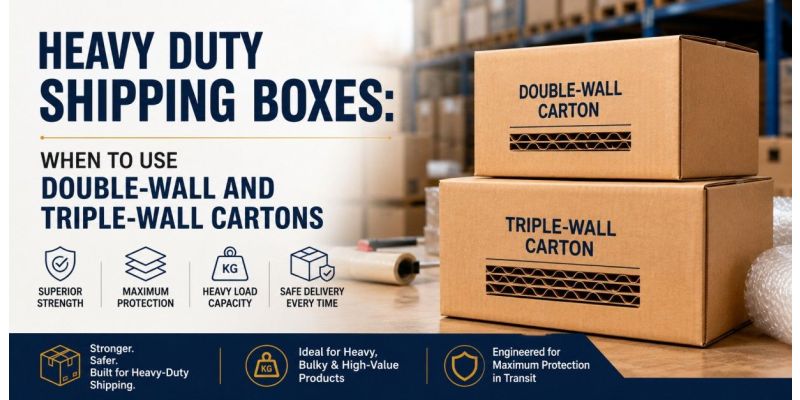
Heavy-duty shipping boxes are double-wall or triple-wall corrugated cartons rated at 275# burst strength or higher - built for products that exceed the safe capacity of standard 32 ECT single-wall boxes. Use double-wall for items 40–100+ lbs, rough freight handling, multi-transit shipments, and anything that will be stacked under other packages in a warehouse or truck. Triple-wall replaces wooden crates for loads exceeding 200 lbs. StarBoxes 275lb double-wall heavy-duty boxes are available in cube sizes from 8"×8"×8" up to 24"×24"×24".
What Makes a Shipping Box "Heavy Duty"?
When packaging suppliers and carriers use the term "heavy duty," they mean the box meets a higher-than-standard structural specification. For corrugated cartons, that means at least one of two things: a higher ECT (Edge Crush Test) rating, a higher Mullen burst strength rating, or - usually both - a switch from single-wall to double-wall construction.
ECT measures the edge-on compressive force a box can withstand before its walls buckle. A 32 ECT box - the single-wall standard used in most e-commerce shipments - withstands 32 pounds of crushing force per linear inch of wall edge. That is sufficient for most products under 40–65 lbs in light handling conditions. A 275lb burst test box is built from heavier linerboard that resists puncture and blowout under direct impact. When a carrier drops a package from 4 feet, the burst test predicts whether the wall holds.
Double-wall construction combines two layers of corrugated fluting with three sheets of linerboard - creating a sandwich that is both thicker (5–7mm vs the standard 3–5mm for single-wall) and more crush-resistant from all directions. This is what StarBoxes 275# heavy-duty boxes use across the entire line, from the 8"×8"×8" up to the 24"×24"×24".
Single-Wall vs Double-Wall vs Triple-Wall: Full Spec Comparison
Here is the complete comparison across the three wall grades.
|
Feature |
Single-Wall (Standard) |
Double-Wall (Heavy Duty) |
Triple-Wall (Industrial) |
|
Wall layers |
1 fluted + 2 liners |
2 fluted + 3 liners |
3 fluted + 4 liners |
|
Thickness |
3–5mm |
5–7mm |
7–10mm |
|
Typical ECT rating |
32 ECT |
44–61 ECT |
61–90+ ECT |
|
Burst test rating |
200# Mullen |
275# Mullen |
400–600# Mullen |
|
Typical weight capacity |
Up to ~65 lbs |
40–180 lbs |
100–400+ lbs |
|
Best for |
E-commerce, under 40 lbs, standard parcel handling |
Heavy items, freight, stacked storage, multi-transit |
Industrial, replaces wooden crates, pallet-shipped machinery |
|
StarBoxes stocks? |
Yes - standard corrugated line |
Yes - 275lb heavy-duty line |
Not currently stocked - consult for custom |
|
Cost vs single-wall |
Baseline |
50–75% more |
150–200%+ more |
Two numbers that confuse buyers most: the 275# rating refers to the Mullen burst test in pounds per square inch - it is not the maximum weight of the items you can put inside. The actual content weight capacity depends on the box size, the ECT rating, and the handling environment. A 275# burst-strength box in a cube configuration like 18"×18"×18" can safely carry 80–100 lbs of product in standard shipping conditions.
When to Upgrade to a Heavy-Duty Heavy-Duty users underestimate how quickly a standard 32 ECT single-wall box degrades during shipping. Each handling cycle - sorting belt, truck ride, warehouse stack, delivery vehicle - reduces effective ECT by roughly 20–30%. A standard box rated 32 ECT after first use may deliver with an effective edge crush of 22–25 ECT. For heavy products, that is a failure waiting to happen at the bottom of a stack.
Upgrade to double-wall heavy-duty boxes when any of the following apply:
- Product weighs lbs or more. Standard single-wall boxes start showibegin to show stress above this threshold, especially at the corners and seams.
- The shipment will be handled by freight carriers (LTL/FTL). Freight handling is materially rougher than parcel - forklifts, conveyor drops, and pallet stacking all exceed the stress assumptions built into 32 ECT ratings.
- Multiple transit legs are involved. A box going from a warehouse → to a regional hub → to a delivery terminal → to the doorstep gets compressed, shaken, and stacked multiple times. Each leg degrades strength.
- The box will be stacked under other boxes during storage. Stacking pressure is measured by ECT - every tier of boxes above adds compressive load. A pallet stacked 5 high with 50-lb boxes puts roughly 200 lbs of compressive force on each bottom-tier carton.
- The product is fragile and heavy. Glass, ceramics, machine components, and heavy electronics that also combine two failure modes: the box crushing and the contents shattering. Double-wall separates the inner and outer stress points.
- International or long-distance freight. Humidity, temperature swings, and extended transit time degrade cardboard. Double-wall construction maintains integrity longer under these conditions.
Triple-wall is the right choice when the weight exceeds 200 lbs, when items are shipped on open pallets without outer carton protection, or when you need a container that replaces a wooden crate. Most e-commerce and mid-size B2B operations never reach this threshold with standard product shipments.
2026 Carrier Requirements and How Your Box Choice Affects Surcharges
This is the angle most box-selection guides miss - and for B2B shippers moving volume, it directly affects landing costs.
Weight Limits: What Each Carrier Accepts
Understanding the weight ceiling for each carrier determines whether a heavy-duty box even gets accepted at standard parcel rates:
- USPS: 70 lbs maximum for all domestic services (Ground Advantage, Priority Mail, Priority Mail Express). Above this, USPS cannot accept the package.
- UPS Ground: 150 lbs maximum per package. Packages over 70 lbs incur an Additional Handling charge. Packages over 50 lbs (UPS Express) also trigger Additional Handling.
- FedEx Ground/Home Delivery: 150 lbs maximum. Additional Handling charges apply to packages over 50 lbs (effective January 2026). Oversize Charge applies to packages over 110 lbs or exceeding 17,280 cubic inches in volume.
The 2026 FedEx Cubic Inch Threshold (New - Often Missed)
Effective January 12, 2026, FedEx expanded the Additional Handling Charge to apply to any package exceeding 10,368 cubic inches in volume - regardless of weight. That means a large heavy-duty box that is light but big can now trigger a surcharge.
For context: a 22"×22"×22" cube box measures 10,648 cubic inches - above the threshold. A 20"×20"×20" cube measures 8,000 cubic inches - below the threshold. For high-volume shippers, this makes the box size decision directly relevant to per-package carrier cost.
The practical implication: right-sizing your heavy-duty box matters more than ever. If your product fits in an 18"×18"×18" (5,832 cubic inches), using a 22"×22"×22" just for safety now carries a FedEx surcharge on top of the box cost difference.
Heavy Duty Box Sizes at StarBoxes: Which Size for Which Product
StarBoxes carries the full range of 275lb double-wall heavy-duty boxes in cube and non-cube sizes. Here is a practical matching guide based on the products most commonly shipped in each size.
|
Box Size |
Cubic Inches |
Carrier Threshold |
Best For (Products) |
|
8"×8"×8" |
512 cu in |
Well below all thresholds |
Dense small items: auto parts, hardware, machine components, collectibles |
|
12"×12"×12" |
1,728 cu in |
Well below all thresholds |
Books, small tools, kitchen appliances, bottles, heavy gift sets |
|
14"×14"×14" |
2,744 cu in |
Below thresholds |
Mid-size appliances, electronics components, boxed power, and tools |
|
16"×16"×16" |
4,096 cu in |
Below thresholds |
Printers, small monitors, sets of heavy glassware, and boxed machinery parts |
|
18"×18"×18" |
5,832 cu in |
Below all thresholds |
Top seller. Home appliances, tool kits, industrial components, and moving heavy household items |
|
20"×20"×20" |
8,000 cu in |
Below, FedEx threatens to hold |
Commercial appliances, large tool sets, bulky industrial items |
|
22"×22"×22" |
10,648 cu in |
ABOVE FedEx AHC 10,368 cu in threshold |
Large sporting equipment, oversized industrial parts - note FedEx surcharge |
|
24"×24"×24" |
13,824 cu in |
Above FedEx AHC threshold |
Bulky oversized items, packing multiple mid-size products together, and moving large household items |
If you are shipping items that frequently land in the 22"×22"×22" or 24"×24"×24" range via FedEx, calculate whether the carrier surcharge makes a smaller, tighter-pac, more tightly packed option more cost-effective. In many cases, two 16"×16"×16" boxes at standard rates cost less in total freight than one oversized box with a surcharge.
How to Pack a Heavy-Duty Heavy-Duty Maximum Protection
A double-wall box is more durable than a standard carton, but it only protects what is correctly packed inside it. Four things determine whether a heavy-duty box survives transit intact:
- Use the H-tape pattern on the bottom seam. Run one strip of heavy-duty packing tape along the center seam, then one strip across each end perpendicular to it - forming an "H." This distributes the load across the entire width of the base rather than relying on the central seam alone. For over 50 lbs, tape the bottom twice.
- Fill the voids. A heavy item rattling inside a box is a damage claim waiting to happen. The item should not shift when you shake the box. Use packing peanuts, bubble wrap, or foam inserts to fill the space between the product and the walls on all six sides. For very heavy items, a base layer of packing peanuts or foam padding under the product helps absorb excess weight from the drop. For StarBoxes 275# double-wall boxes, the safe operational range is 40–100 lbs, depending on box size. Overloading increases seam stress and dramatically raises the risk of failure at the bottom corners - the weakest structural point on any corrugated box.
- Seal the top seam with the same H-tape pattern. Carriers compress, sort, and stack boxes in orientations you never intended. A wintendedaled top prevents the box from opening under stacking pressure or inversion during handling.
For fragile heavy items, combine the heavy-duty box with an inner layer of large 1/2" bubble roll along the walls and a base layer of packing peanuts. We cover the full void-fill comparison - packing peanuts, bubble wrap, and packing paper - in our separate guide to packing peanuts types and uses.
Frequently Asked Questions
1. What is a heavy-duty ox?
A heavy-duty corrugated carton is a corrugated carton built with double-ll or triple-wall construction, rated at 275# burst strength or higher. The double-wall structure uses two layers of corrugated fluting sandwiched between three sheets of linerboard, making it 50–75% thicker than a standard single-wall box and capable of carrying 40–180 lbs, depending on size.
2. When should I use a double-wall box instead of a standard box?
Use a double-wall box when your product weighs 40 lbs or more, when the shipment will be handled by freight carriers, when boxes will be stacked during storage, or when the product is fragile and heavy. Standard 32 ECT boxes degrade 20–30% in effective strength per handling cycle and are not reliable above 65 lbs.
3. What does 275lb mean on a corrugated box?
The 275lb rating refers to the Mullen burst test - the amount of force (in pounds per square inch) required to punch through the box wall. It is a measure of puncture resistance, not the maximum weight of contents. A 275lb burst-rated box can typically hold 40–100 lbs of product depending on size and handling conditions.
4. What is the difference between ECT and burst strength for boxes?
ECT (Edge Crush Test) measures how much compressive force the box wall withstands when standing upright - relevant for stacking. Burst strength (Mullen Test) measures puncture resistance - relevant for individual parcel shipping where drops and impacts are the primary risk. For warehouse stacking, prioritize parcel shipping; burst strength matters more.
5. Where can I buy heavy-duty shipping boxes near me?
StarBoxes ships heavy-duty orders nationwide and same-day carrier pickup on orders placed before 3 p.m. EST - making bulk orders available the next day for most US locations. All 275lb double-wall heavy-duty sizes are in stock, from 8"×8"×8" up to 24"×24"×24".
6. How much weight can a heavy-duty shipping box hold?
StarBoxes 275lb double-wall heavy-duty boxes safely hold 40–100 lbs, depending on box size. Smaller cube sizes (8"–12") are rated for the higher end of that range relative to their interior volume; larger cubes (22"–24") handle up to 80–100 lbs. Never exceed the rated capacity - corner seams fail first under overloading.
7. Do UPS and FedEx have requirements for heavy-duty carriers to accept heavy-duty corrugated boxes?
FedEx applies Additional Handling Charges to packages exceeding 50 lbs or 10,368 cubic inches (effective January 2026). UPS applies Additional Handling for packages over 50 lbs (express) or 70 lbs (ground). USPS has a hard 70-lb weight limit for all services; shipments above that limit must use UPS, FedEx, or freight.
Choosing the Right Heavy Duty Box for Your Operation
The decision framework that covers most situations: move to double-wall at 40 lbs or any time, whenever frameworks, stacking, or multi-transit handling are involved. Size the box as tightly as possible around your product - especially if you ship FedEx and want to stay under the 10,368 cubic-inch Additional Handling threshold. Always use the H-tape pattern and fill voids.
StarBoxes 275lb double-wall heavy-duty boxes are available in cube sizes from 8"×8"×8" through 24"×24"×24" at wholesale bulk pricing, in stock and ready to ship.
Shop the complete heavy-duty boxes collection - or request a custom bulk quote for volume pricing on pallets and LTL freight quantities.