





What if the reason your shipping costs keep rising has nothing to do with rates, fuel, or volume?
Most teams believe shipping costs are decided at the carrier level through negotiated rates and service levels. That belief holds until the numbers stop lining up.
Orders remain steady. Products weigh the same. Fulfillment runs on time. Yet invoices keep climbing. Not suddenly. Quietly. Consistently. Enough to erode the margin without triggering an obvious red flag.
The problem does not look like a problem.
The box feels appropriate. The protection feels responsible. The shipment moves without delay. Nothing fails. Nothing breaks. And that is why this cost repeats.
Here is what is actually happening.
Carriers are not always charging you for weight. At a certain point, they switch to charging you for space. That switch is called dimensional weight. There is no alert and no manual review. The charge simply applies.
This is how shipments become expensive without any visible mistake.
Once you understand dimensional weight, rising shipping costs stop feeling random and start feeling predictable.
What Is Dimensional Weight in Packaging?
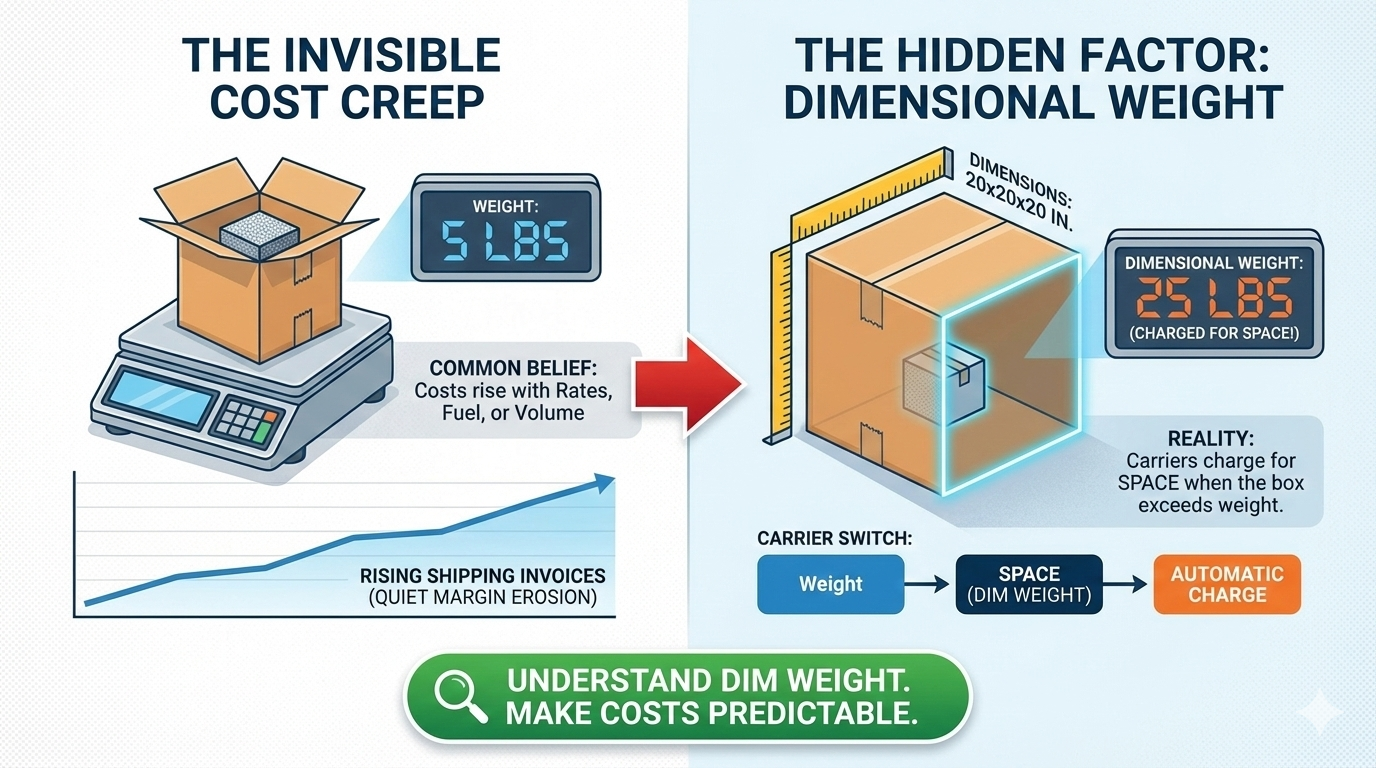
Dimensional weight (DIM weight) is a way shipping companies decide how much to charge for a package based on how much space it takes up, not just how heavy it is.
Instead of only weighing a box, carriers also measure its length, width, and height. From these measurements, they calculate a “dimensional” or “volumetric” weight. When it’s time to bill, they compare:
- The actual weight of the package
- The dimensional weight based on size
Dimensional Weight vs Actual Weight
Actual weight is the physical weight of a package when it is placed on a scale. Dimensional weight is calculated based on the package’s size, its length, width, and height. Shipping carriers use dimensional weight to account for packages that are lightweight but take up a lot of space during transport.
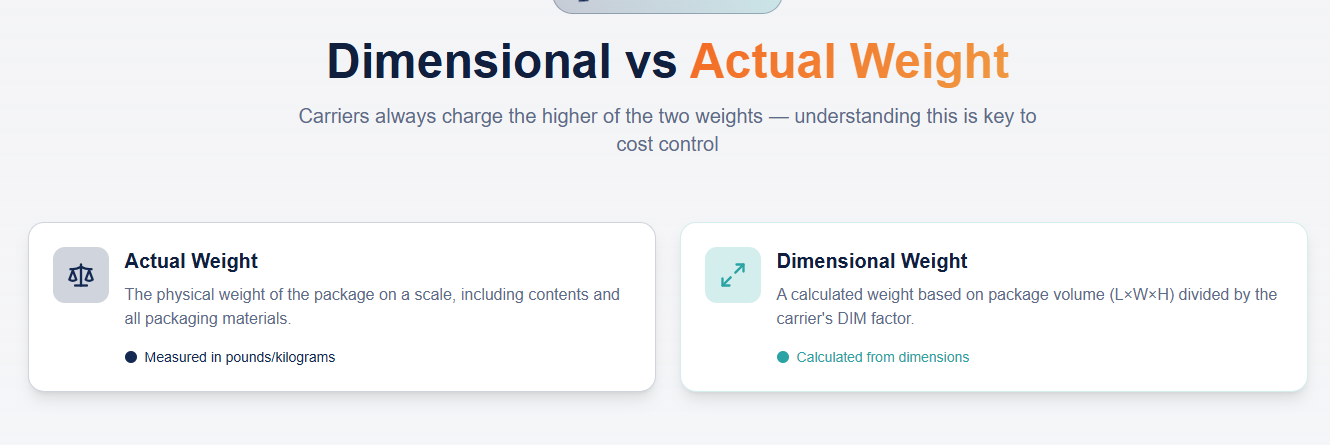
When calculating shipping costs, carriers compare both the actual weight and the dimensional weight of a package. The shipping charge is based on the higher of the two weights. This helps carriers use space efficiently and explains why larger boxes can cost more to ship, even if they are not heavy.
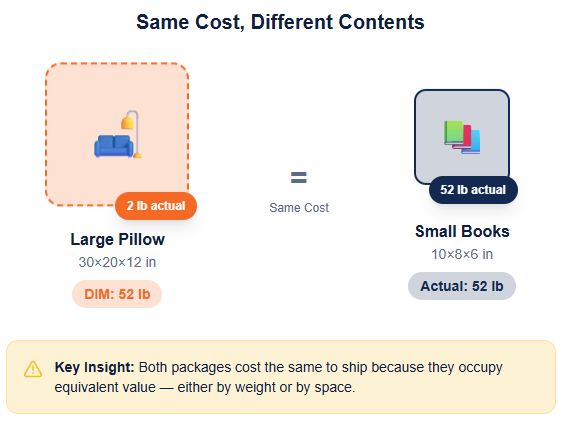
This system exists because space on trucks and planes is limited. A large but lightweight box can take up as much room as a small, heavy box, so both may cost the same to ship.
For example, shipping a pillow in a big box can cost more than shipping a small box of books, even though the pillow weighs less. That’s because you’re paying for the space the box occupies.
Dimensional weight is also called volumetric weight or cubed weight, and it’s used by major carriers like FedEx, UPS, USPS, and DHL. The simplest way to avoid higher shipping costs is to use a box that closely fits your item, so you’re not paying to ship empty space.
StarBoxes combines packaging expertise with shipping intelligence to help businesses optimize box design, control dimensional weight, and reduce shipping costs while ensuring safe and efficient transport.
How Is Dimensional Weight Calculated?
Dimensional weight is calculated by multiplying the length (L), width (W), and height (H) of a package, then dividing the result by a carrier-specific DIM factor or divisor.
Formula:
Dimensional Weight = (Length × Width × Height) ÷ Dimensional Factor
- Measurements are typically in inches for domestic shipments or centimeters for metric shipments.
- FedEx and UPS use 139 in³ per pound as the standard divisor for most domestic shipments.
- Carriers round up any fractional result to the next whole pound.
Practical Steps
- Measure package dimensions – Record length, width, and height, rounding up to the nearest inch.
- Compute volume – Multiply L × W × H to get cubic inches.
- Apply the divisor – Divide volume by the DIM factor (e.g., 139 for FedEx/UPS domestic).
- Round up – Round the result to the nearest whole pound. Billing is based on whichever is higher: dimensional or actual weight.
Example Calculation
|
Box Dimensions |
Volume (in³) |
DIM Factor |
Dimensional Weight (lb) |
Actual Weight (lb) |
Billable Weight (lb) |
|
12 × 12 × 6 |
864 |
139 |
6.2 (rounds to 7) |
4.5 |
7 |
|
18 × 18 × 18 |
5,832 |
139 |
42 (rounds to 42) |
10 |
42 |
|
10 × 5 × 5 |
250 |
139 |
1.8 (rounds to 2) |
15 |
15 |
The billable weight is always the higher of the actual weight and the dimensional weight.
Why Do Carriers Use Dimensional Weight?
Carriers introduced dimensional weight to more accurately reflect the cost of transporting bulky, lightweight items. In the past, shippers could send large, lightweight items such as pillows, foam products, or textiles for minimal cost, which was inefficient.
By incorporating dimensional weight, carriers ensure that space usage in trucks or planes is accounted for. FedEx notes that using oversized boxes without proper packaging can lead to “paying to ship air.” StarBoxes emphasizes that understanding and managing dimensional weight not only controls cost but also optimizes space utilization across supply chains.
Since 2015, FedEx and UPS have applied dimensional weight to nearly all ground shipments. The standard DIM factor for domestic services is 139 in³ per pound, although some carriers use 166 or 194 for certain zones or package types.
Dimensional Weight vs Actual Weight
Actual Weight – The weight of the package on a scale, including contents and packaging.
Dimensional Weight – A calculated weight based on package volume and the carrier’s DIM factor.
Carriers always charge the higher of the two, making dimensional weight as critical as actual weight for many shipments.
Example Table
|
Package Type |
Dimensions (L×W×H) |
Actual Weight (lb) |
Dimensional Weight (lb) |
Billable Weight (lb) |
|
Small Dense Item |
10 × 5 × 5 |
15 |
2 |
15 |
|
Large Lightweight |
30 × 20 × 12 |
12 |
52 |
52 |
|
Medium Balanced |
20 × 15 × 10 |
30 |
22 |
30 |
This demonstrates why packaging optimization often saves more money than weight reduction.
How Packaging Decisions Affect Dimensional Weight
Dimensional weight is determined by the outer package dimensions, not the internal materials. Common causes of higher DIM charges include:
- Oversized cartons chosen for convenience
- Excess void space inside boxes
- Inefficient product orientation
- Limited box size options
Using bubble paper or bubble roll for protection does not increase dimensional weight unless it forces a larger outer box. StarBoxes advises businesses to right-size boxes and select materials that protect without increasing volume unnecessarily.
How to Reduce Dimensional Weight Charges
Smart packaging choices can reduce dimensional weight significantly:
- Use Right-Size Boxes: Select the smallest box that safely accommodates the item. Even reducing each dimension by an inch can drop the DIM weight to a lower billing tier.
- Alternative Packaging: For lightweight, non-fragile products such as clothing or books, padded mailers or poly mailers conform to the product and often avoid dimensional weight entirely.
- Minimize Void Fill: Use lightweight cushioning such as crumpled paper or recycled pads instead of bulky fillers. Efficient packing prevents paying for air.
- Evaluate Package Design: Custom-sized boxes or multi-depth cartons can eliminate wasted space. StarBoxes recommends considering modular inserts or algorithmic box sizing to match packaging precisely to product dimensions.
- Monitor Carrier Divisors: High-volume shippers may negotiate favorable DIM factors with carriers, but the standard factors (e.g., 139 in³/lb) should always be used for planning and cost estimation.
A Smarter Way to Control Shipping Costs
Dimensional weight plays a bigger role in shipping costs than many teams realize. When package size drives pricing, even small inefficiencies add up fast. Once we understand how dimensional weight is calculated, and when you factor it into packaging decisions, cost control becomes much more achievable.
Using right-sized boxes, reducing empty space, and choosing flexible packaging where appropriate can lower billable weight without compromising protection. These choices do more than reduce spend. They also cut wasted space in transit, supporting more efficient and responsible shipping practices.
If you are looking to bring more predictability into shipping costs and make packaging work harder for your business, StarBoxes offers practical expertise to help you design smarter packaging strategies that balance cost, protection, and efficiency.
Frequently Asked Questions
1. When is dimensional weight applied?
Dimensional weight is applied whenever calculated DIM weight exceeds actual weight. Since 2015, all FedEx and UPS ground shipments have followed this rule. USPS applies DIM pricing for Priority and Express parcels above certain thresholds.
2. What is the formula for dimensional weight?
Dimensional weight equals Length × Width × Height divided by the DIM factor. Use consistent units: inches/pounds or centimeters/kilograms.
3. How does dimensional weight affect shipping cost?
The higher of DIM weight and actual weight becomes the billable weight. Light-but-bulky packages are often charged based on DIM weight, which increases shipping costs if packaging is inefficient.
4. Does dimensional weight apply to international shipments?
Yes. International carriers also use volumetric weight, usually with a different divisor (often 5000 cm³ per kg or equivalent). The higher weight is billed.
5. How can I determine my package’s dimensional weight?
Calculate manually using the formula or use online DIM calculators provided by FedEx, UPS, or other carriers. StarBoxes recommends pre-calculating DIM weight to avoid surprises on invoices.